Published 13 November 2025
Dryland farming is both an advantage and a challenge. When the rain comes at the right time, the Free State becomes some of the most productive maize land on earth. When it doesn’t — every decision matters. At Maritz Nel Family Trust, we’ve spent five generations adapting, improving, and testing new approaches to make sure our land remains productive, healthy, and ready for the future.
One of the most powerful systems that’s transformed our soil and our livestock health is the integration of grazing with maize production. It’s simple in concept, deeply efficient in practice, and grounded in sustainable thinking:
The crops feed the cattle. The cattle feed the soil. The soil feeds the crops.
This article explains exactly how — and why — combining livestock and maize creates resilience, ecological balance, and improved profitability on dryland farms like ours.
Why We Integrate Crops and Cattle
There was a time when South African farms became more and more specialised — livestock producers grazed veld only, while grain farmers pushed animals off the croplands. It worked for yield — but not for soil.
Over time, we saw:
- Loss of organic carbon
- Lower natural fertility → higher fertiliser costs
- Harder soils with reduced water infiltration
- Increased vulnerability to drought
- More pests and weed pressure
Reintroducing livestock on cropland reverses those effects naturally.
Benefits at a glance:
- Restores soil biology
- Increases nutrient cycling
- Improves water retention
- Maximises land productivity year-round
- Reduces feed and fertiliser costs
- Builds resilience in drought years
Where monocropping slowly depletes a farm, integration enriches it.
The Principle: Every Season Has Two Harvests
In dryland farming, every growing season gives us a primary harvest — maize. But the season doesn’t end when the combine leaves the field.
The remaining biomass becomes a second, often more valuable harvest:
- Stalks
- Cobs
- Leaves
- Root residues
To a cow — that’s food.
To a soil microbe — that’s a feast.
To a farmer — that’s free fertility.
What cattle convert into meat and manure, the soil converts into future yield.
Instead of burning residue or leaving it to weather, we harvest nutrition twice — first into a silo, then into a herd.

How Our Grazing System Works
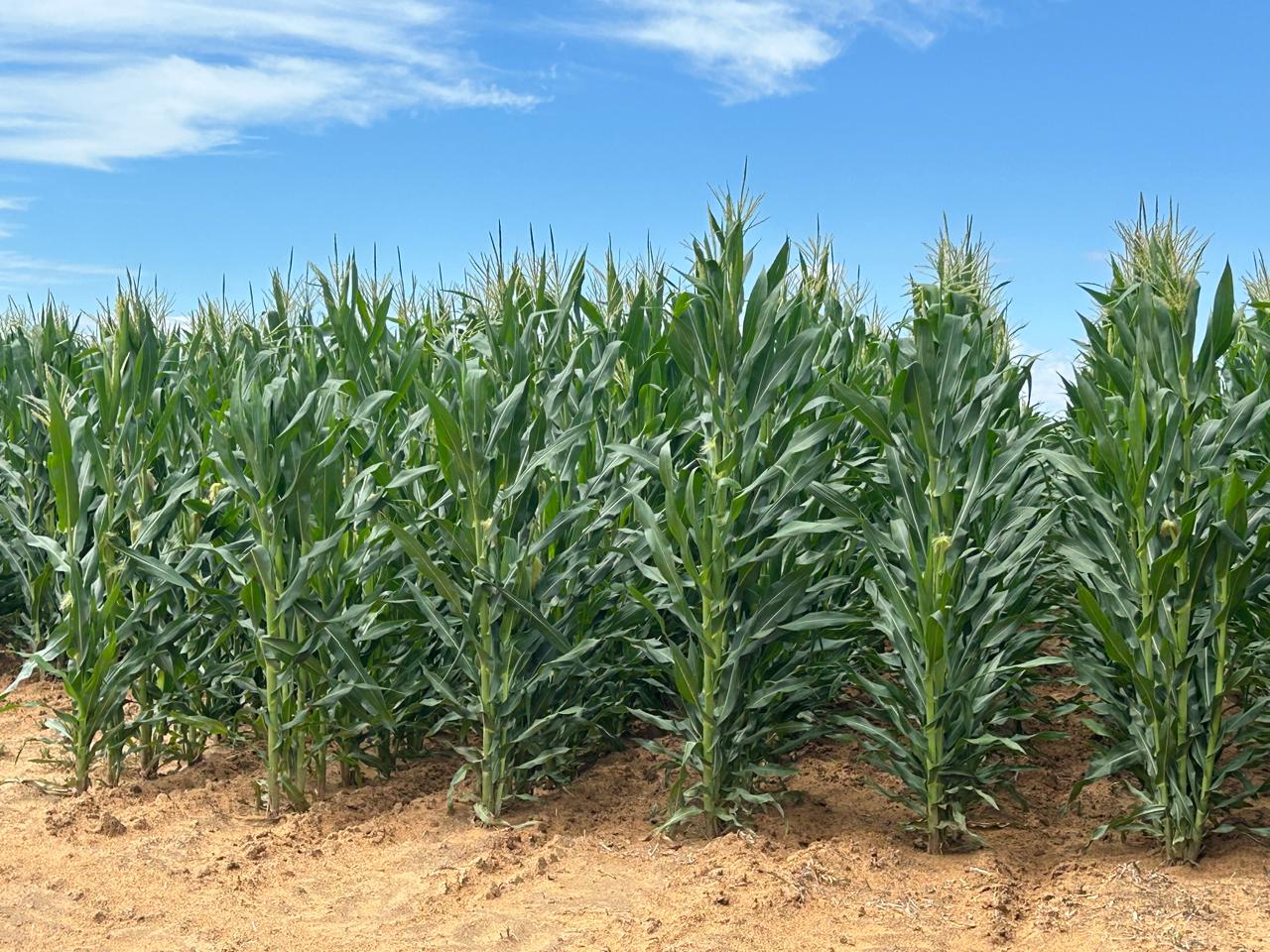
Step 1 — The maize crop
We plant maize for local and national grain markets. Our management focuses on:
- Rest-land planning
- Strategic fertilisation
- Weather-resilient hybrids
- Timed planting for dryland moisture
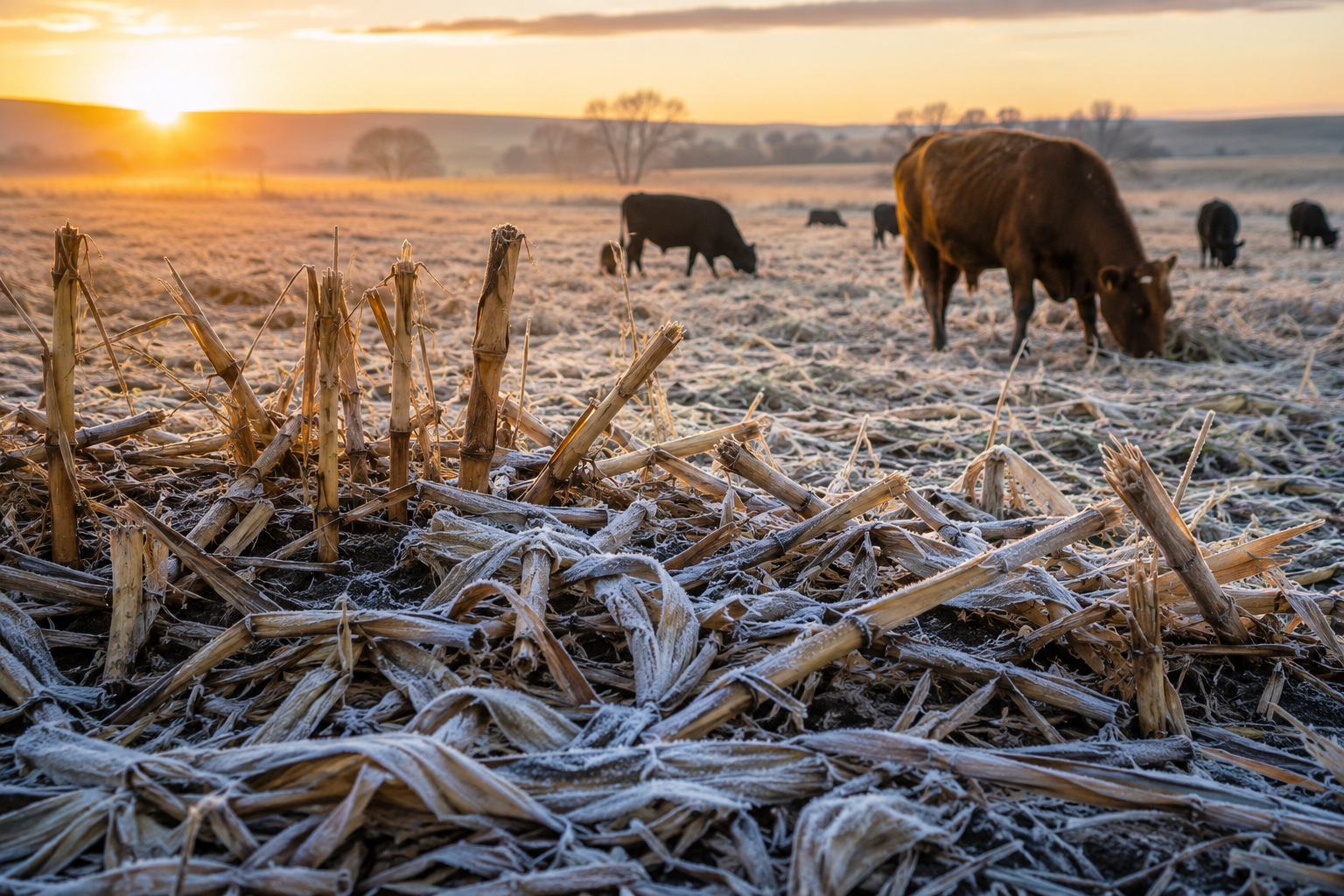
Once the crop is harvested and removed, the residue is left standing.
Step 2 — Controlled livestock access
We use rotational strip grazing with temporary electric fences:
- Cattle are allowed into a section for 2–5 days
- Never long enough to degrade soil cover
- Then moved to the next strip
This ensures:
- even residue utilisation
- targeted trampling → stronger seed-to-soil contact
- protection of soil surface
Step 3 — Natural nutrient cycling
As cattle eat and move:
- Manure reintroduces organic nitrogen
- Hoof action breaks down residues
- Microbial activity spikes as carbon enters the soil
It’s the most efficient and cost-free fertiliser system available.
The Science Behind “Cow Power”
When a cow processes a meal of maize stalks and veld grass, valuable nutrients are returned to the land:
| Nutrient | Returned to soil via manure | Why it matters |
| Nitrogen (N) | ~80–90% of intake | Plant leaf growth + protein in maize kernels |
| Phosphorus (P) | ~70% | Root development + energy storage |
| Potassium (K) | ~90% | Water-use efficiency and disease resistance |
| Carbon | High amounts | Soil structure + microbial habitat |
A single cow can cycle up to 25–35 kg of nitrogen per year into soil — and we don’t pay a cent for it.
When this happens across hundreds of hectares?
→ Fertiliser becomes a supplement, not a dependence.
Resilience in the Free State Climate
Dryland farms in the Northern Free State must be drought smart:
- Some years deliver 750 mm of rain
- Others struggle to see 350 mm
During low-yield seasons, grazing protects the bottom line:
- When there’s less grain, there’s still grass and stubble
- Livestock can convert marginal biomass into marketable kilograms
Cattle are our best drought insurance policy.
They protect the business when the weather doesn’t.
Soil Health: The Long-Term Return
Healthy soil is living soil. We track improvements in:
- Earthworm presence
- Soil carbon %
- Infiltration after thunderstorms
- Water retention during heatwaves
- Reduced erosion on slopes
Over recent years, we’ve seen measurable progress:
- Increased ground cover across seasons
- Better yields on previously weaker lands
- Faster recovery after dry spells
We create a soil sponge, not a dust bowl.
Our Grazing Strategy for Balance
We’ve learned hard lessons along the way. Improper grazing can damage land just as easily as help it.
So we follow strict rules:
| Principle | How we apply it |
| High density, short duration | Big herd, rapid movement = minimal damage |
| Residue always remains | Never let cattle reduce cover below 50% |
| Rotation based on recovery time | Not calendar or convenience |
| Seasonal adjustments | Wet years = more grazing; dry years = lighter pressure |
| Monitor animal nutrition | Supplement as required — animals come first |
We’re not chasing maximum grazing; we’re chasing maximum regeneration.
Biodiversity Boost: More Than Crops & Cattle
An unexpected win: more wildlife.
Since integrating grazing:
- Bird species have increased
- Soil invertebrates thrive under manure patties
- Natural predators control pests
We’re not just growing maize —
we’re supporting an ecosystem.
Profitability: More than Just Yield per Hectare
Traditional thinking measures maize success in:
tonnes per hectare
Our system measures:
tonnes + kilograms of beef + soil health + risk reduction
Meaning our farm makes income from:
- Grain sales
- Livestock growth
- Reduced fertiliser expenditure
- Higher long-term productivity
In modern farming, diversified revenue = stability.
Challenges & How We Manage Them
We’re honest — this system isn’t frictionless.
| Challenge | Response |
| Cattle can compact soil if unmanaged | Keep moves fast + avoid wet conditions |
| Nutrition varies by season | Provide lick/supplements when required |
| Fencing and labour demands | Invest in efficient move-systems |
| Weather unpredictability | Plan stocking rates conservatively |
Where challenges exist, management solves them.
Looking Forward: Our Regenerative Path
We are continuing to evolve the system. Next expansions include:
- Increased cover cropping between maize seasons
- More multi-species pastures for soil biology support
- Data-tracking of carbon improvements
- Precision technology for pasture monitoring
We believe the future of dryland farming is built on:
- diversity
- roots in the soil year-round
- animals as partners, not passengers
Our aim?
Leave the land healthier every year — for the next generations of Maritz farmers.
Conclusion: Integration Is Our Competitive Advantage
The success of grazing-maize integration at Maritz Nel comes down to a simple truth:
Everything on the farm must have a purpose.
Cattle turn crop residue into soil fertility.
Healthy soil grows stronger crops.
Stronger crops support stronger cattle.
It’s a full-circle system that protects our land, strengthens our business, and builds a sustainable agricultural legacy in the Northern Free State.
We’re proud that our approach not only works today — but invests in tomorrow.
Want to Learn More or Work With Us?
We welcome partnerships with:
- Feedlot and livestock buyers
- Grain processors and millers
- Sustainable agriculture researchers
- Local community initiatives
📍 Based in Hennenman, Northern Free State
🌾 Specialists in dryland maize, soya, and livestock integration
Let’s grow a future that feeds South Africa — sustainably.